Potential major DRM issue rolled out by PlayStation (and Xbox as well, allegedly). All new PSN purchases now have a 30 day validation countdown. Already investigating to find out more details. pic.twitter.com/4hqMdWfJ2T
— Does it play? (@DoesItPlay1) April 25, 2026
PlayStation has seemingly added a 30-day DRM check to all newly purchased digital PS4 and PS5 games
Tests suggest players won’t be able to play their digital games if they go 30 days without connecting online
A growing number of PlayStation 4 and PlayStation 5 users have reported that new digital purchases on each console have introduced DRM requiring online activation every 30 days.
As originally reported by YouTube channel Modded Warfare, the new version 13.20 update for the PlayStation 5 console appears to have also brought with it a form of digital rights management (DRM) in which digitally purchased games have to be verified going forward.
According to the channel, then also tested by Twitch streamer and modder Lance McDonald, any game purchased on or after a certain date appears to have a 30-day timer applied to it. If the player doesn’t play the game for 30 days, they will have to connect their console online to renew the license and reset the timer to 30 days again.
Contrary to some belief on social media, this doesn’t mean that if the 30-day limit expires, players will lose access to their game forever – it means that after the timer runs out, players won’t be able to play the game again until they connect their console online, so it can perform a validation check.
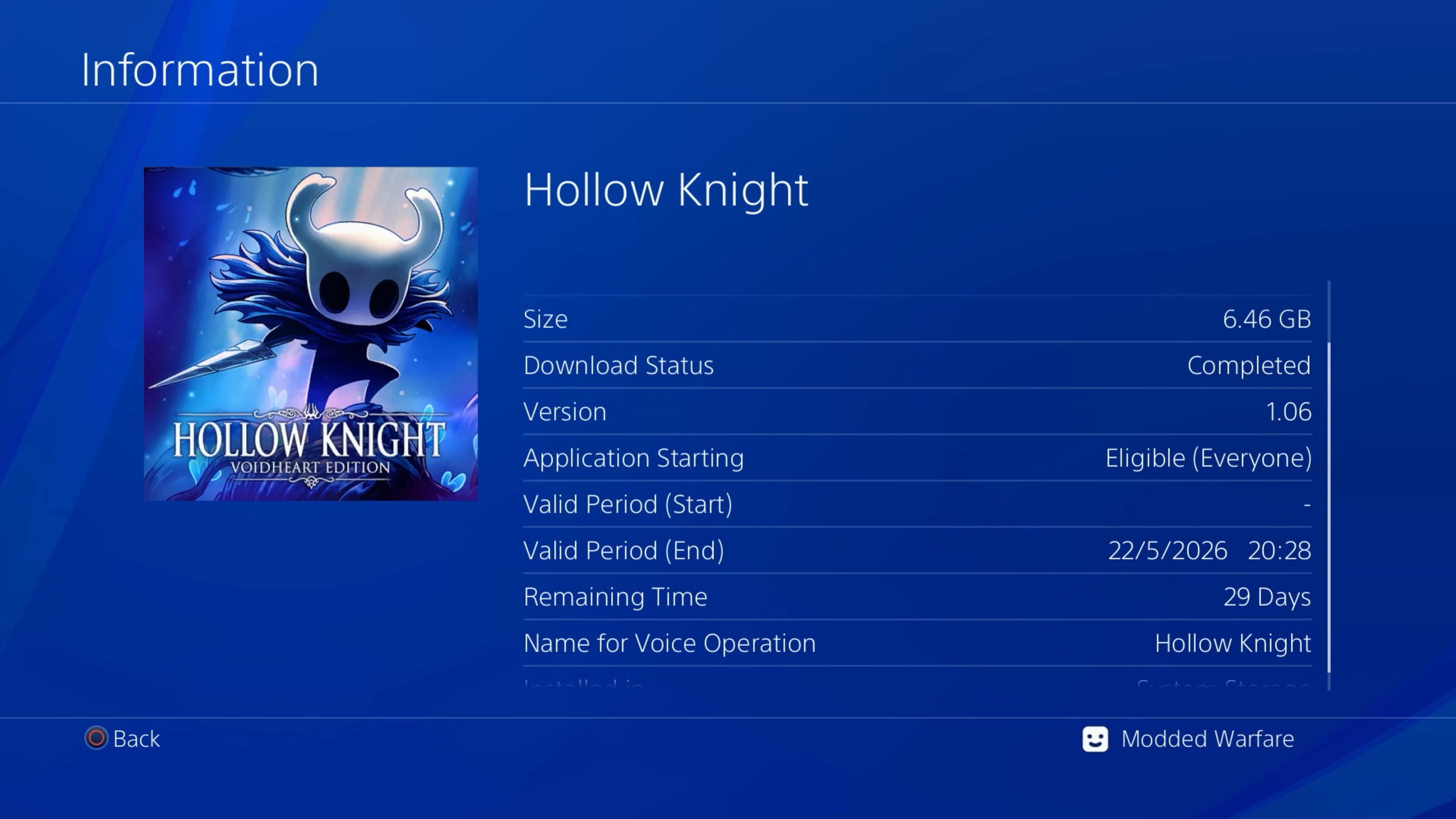
While the issue reportedly affects both PS4 and PS5 games, the timer can only be seen on PS4. Players who check the information section on a purchased game on PS4 will now see Valid Period (Start), Valid Period (End), and Remaining Time information for that game. This timer also reportedly exists on PS5, but can’t be seen – players will only be notified when the timer runs out, and they try to play a game.
The issue doesn’t appear to affect any game that has been previously purchased. Players have been testing their existing digital games, and none of them have this timer. However, reports suggest that all games purchased after a specific date – believed to be some time in mid-April – will now have this timer applied.
This was also tested by YouTuber Spawn Wave, who tested out four games on his console: two digital games he purchased after the reports started, a digital copy of Crimson Desert he bought before the reports, and a disc copy of Pragmata.
All four games run as normal on his PS5 console, whether he has the console connected online or not, because the 30-day timer has yet to expire. However, he then removed the CMOS battery from his console – this runs the console’s internal clock, and because removing it means the PS5 can no longer check the real date or time, it simulates the 30 days running out.
With the CMOS removed, Spawn Wave’s previously purchased copy of Crimson Desert and his disc copy of Pragmata continued to run without issue, because there were no checks on their validity. The two games he purchased after the reports emerged, however, failed to run, with an error message saying: “Can’t use this content. Can’t connect to the server to verify your license.”
While this apparent new change will have no impact on the vast majority of players, it does have a short-term impact on players who have sporadic access to internet connections and tend to mostly play their console offline.
Its long-term impact is of greater concern to some players, however. If the timers are the new standard going forward, should Sony ever turn off the PS4 or PS5 servers in the distant future, players would have to rely on the CMOS to verify games. When the CMOS battery runs out, it will theoretically no longer be able to verify and therefore play any digital games purchased after mid-April 2026.
A similar controversy around this occurred in 2021, when players expressed concern that a dead or removed CMOS battery on PS4 would render games unplayable on the console – referred to by players as the ‘CBOMB’ issue. Sony released a firmware update for PS4 in September 2021, which fixed the issue, ensuring games can still be played with a dead CMOS.
If these new 30-day timers are no accident, however, and Sony is implementing this as a new policy, some players are worried that the problem has returned.
X account Does it Play, which tests commercial releases online to ensure they can still be played in the future, posted: “Remember the CBOMB that killed your games on PS3, PS4, and PS5 once the CMOS battery depletes? Sony essentially has to fix the current DRM issue as it basically rearmed the CBOMB for new purchases.”
While some players are reporting that Sony support chatbots have started acknowledging the change, Sony has yet to make an official statement confirming whether this is a deliberate new move or a mistake that was implemented with the new patch and will be fixed in the future.
VGC has asked Sony for comment and will update this story if we receive a response.
Modded Warfare speculates that the change may have been implemented to prevent jailbreaks, because a number of digital PS5 games, such as Star Wars: Racer Revenge and Don’t Starve Together: Console Edition, can be used to trigger exploits in the hardware and jailbreak the console’s kernel, opening it up to homebrew and piracy.
“So far there’s not been anything they can do about that because they can’t exactly just take away people’s games,” he said, noting that the new 30-day timer means those methods no longer work because jailbroken consoles tend to be kept offline to avoid bans.
“Generally, we cannot reply on these digital games being used as entry points to trigger kernel exploits because once you put your console offline for over 30 days, it will then require a connection to PSN to allow you to run that game,” he explained.










Some external links on this page are affiliate links, if you click on our affiliate links and make a purchase we might receive a commission.