One in three games industry professionals surveyed by GDC were laid off in the past two years, more than in its last report
More than half are still unemployed, and a quarter have applied for at least 100 jobs

More than a third of games industry professionals responding to a new survey said they were laid off in the past two years.
The 15th edition of the State of the Game Industry survey, which is managed by the GDC Festival of Gaming (Game Developers Conference) and surveys more than 2,600 games industry professionals around the world, asked its respondents a number of questions about various aspects of development, including layoffs.
The survey found that 34% of those surveyed had been laid off at some point in the last two years, a number which increases to 39% when only counting those in the United States.
This is higher than in the GDC‘s last survey, which was published in January and reported that 28% had been laid off in the past two years (33% in the US).
Of those who said they had been laid off, a quarter said it had most recently happened to them in the past three months, while a further 43% said it had happened between 3-12 months ago.
17% of them said they had been laid off twice in the past two years, while 3% said they had been laid off three or more times in that period.
More than half (54%) said they were still unemployed (rising to 59% in the United States), and that it’s not through a lack of trying – 27% of those who had been laid off in the past two years (whether they have since found work or not) said they had submitted at least 100 job applications.
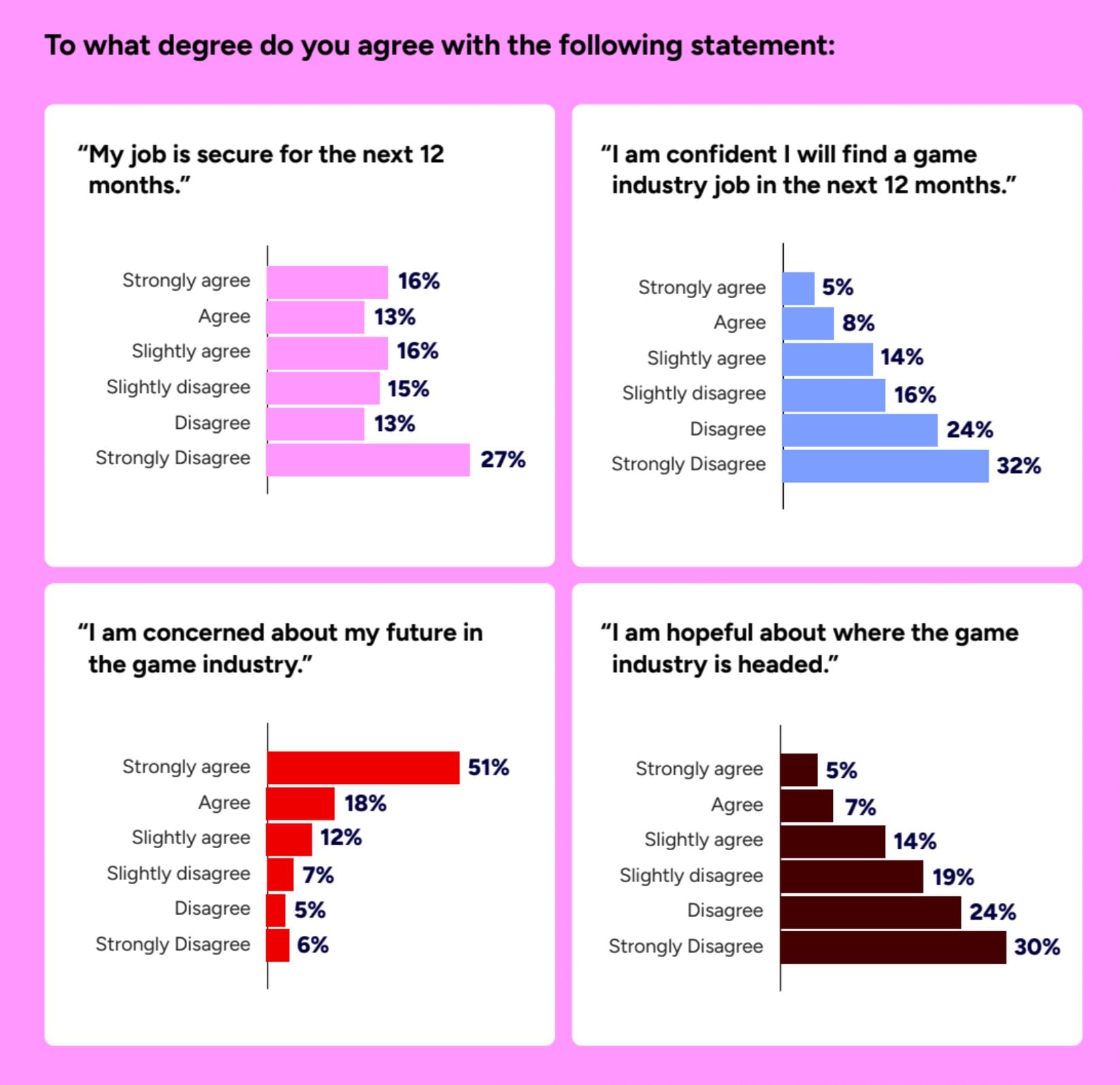
Elsewhere in the survey, only 45% of those respondents who are currently employed said they at least slightly agreed with the statement “my job is secure for the next 12 months”. Of those unemployed, 72% said they weren’t confident they’d find a new job within the next year.
The general morale appears to be low around the industry – 81% of all respondents agreed with the statement “I am concerned about my future in the game industry”, with 51% saying they agreed strongly with it.
Similarly, 73% said they disagreed with the statement “I am hopeful about where the game industry is headed”.
The report also quotes the co-founder of an independent studio in Nevada – whose identity isn’t revealed, given the nature of the survey – who criticised the decision of games industry executives who chose not to train new talent, then ended up laying off veteran developers anyway.
“To be honest, the next five years are going to be a fight over whether games stay a creative profession or become a financial asset-management business,” they said.
“Also, a thing I think is really, really funny – the game industry spent years refusing to train junior devs because they ‘needed experienced talent,’ then spent the last few years laying off experienced devs because of the cost.
“You can’t simultaneously refuse to let people become experienced and then fire them when they are. What did y’all think was going to happen? You don’t get to eat the seed corn and then whine when nothing grows.”
Although some may interpret the figures as a suggestion that the games industry is shrinking, it should be noted that the report’s participants skewed heavily towards Western developers, with only 6% of respondents from East, South and Southeast Asia (and most of these from Japan).
At this year’s Gamescom Dev opening keynote, 1Up Ventures general partner Amir Satvat suggested that around 750,000 people are employed in the games industry globally, a number much higher than that usually reported.
“The reason this often gets very undercounted in my opinion is people don’t understand the extent of employment in China,” Satvat said at the time (as reported by GamesIndustry.biz).
Satvat suggested that despite all the layoffs happening in the West, “the industry is actually net positive in terms of employees from 2022 until now” when considered on a global scale, and that what’s happening is “head count moving from basically North America to basically anywhere else”.