Numerous video game company share prices dropped following Google’s Project Genie AI rollout
Unity’s CEO made a statement after the tool, which lets users create ‘playable worlds’, saw its shares crashing 35%

A number of video game companies have seen their share prices fall in the wake of Google’s rollout of Project Genie.
The company announced last week that it had started rolling out a prototype version of Project Genie, an AI tool that lets users generate their own playable worlds.
According to Google, users can create worlds by either typing in prompts or uploading images. They then create their character in a similar way.
Users can also define certain other properties, such as how the character moves, or whether the world is explored in first-person or third-person. As players explore the world, the tool generates it in real-time depending on the actions the player makes and where they move the camera.
Some users have already started sharing videos of their creations on social media, some of which include copyrighted characters.
Following the rollout of the tool, a number of video game companies on the Nasdaq stock exchange saw notable drops in their share price.
The most notable of these drops was that of Unity, which saw its share price close at $38.40 the previous day then plummet to as low as $27.80 at one point the following day, a drop of 35%. Other drops included CD Projekt, Nintendo, Roblox and Rockstar parent company Take-Two.
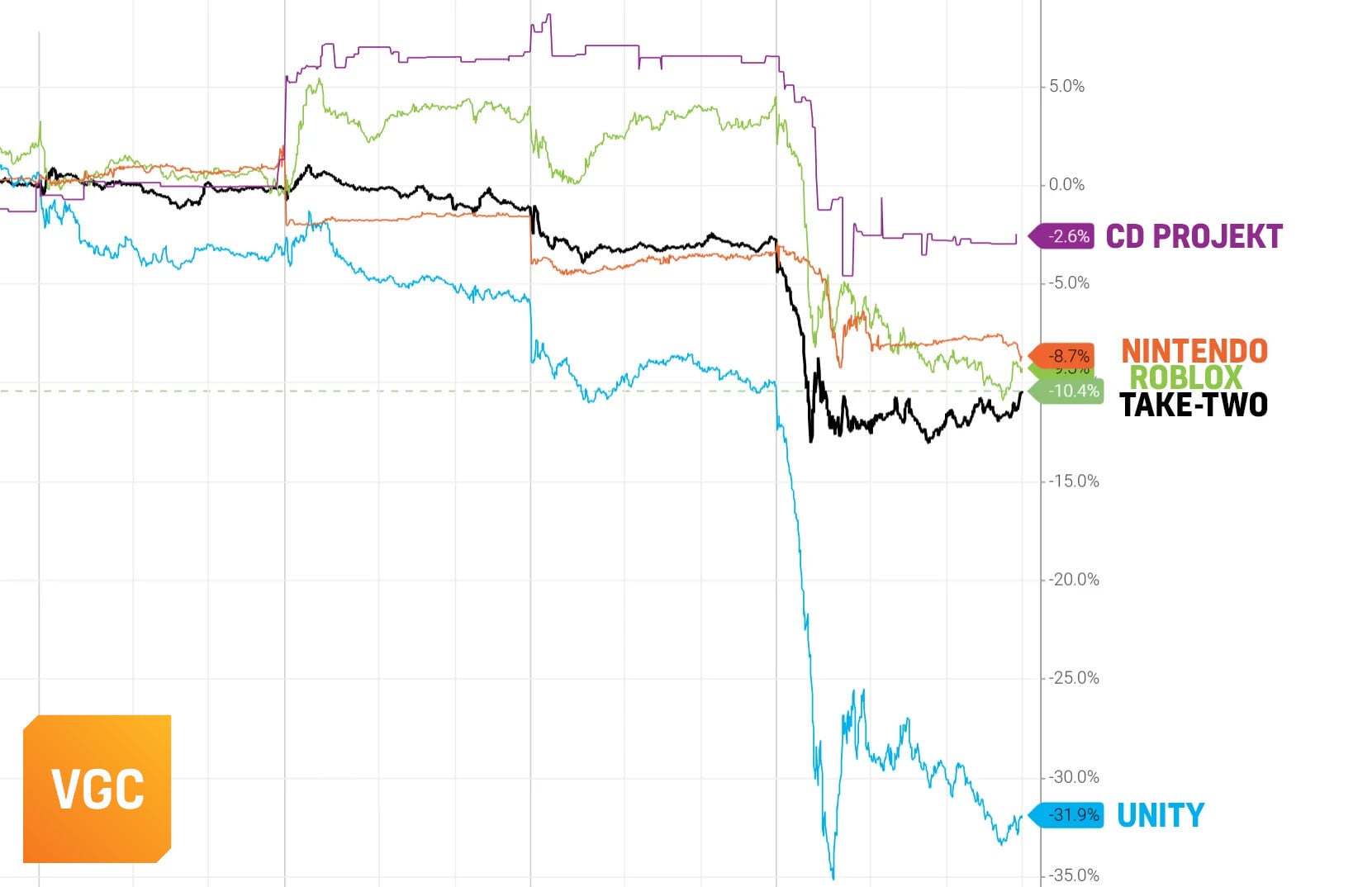
Pro-AI enthusiasts have already started suggesting that, should such Project Genie continue to evolve, it could reduce the need for game developers (without noting its significant current limitations).
However, William Blair analyst Dylan Becker told Bloomberg that these concerns were “overblown”. Evercore ISI analyst Robert Coolbrith added that, “We think the moves we see in gaming stocks today largely discount the importance of: creativity and social/network effects in open world gaming”.
The numerous drops in share price across the industry appear to be an immediate reaction to those theories, as investors’ initial response seems to be that such companies could be negatively affected by Google’s tech.
Reacting to his company’s large drop in value, Unity CEO Matthew Bromberg posted a message on X stating that the growth of such AI ‘world model’ creators are a positive for the industry, and that Unity will actually be making use of them rather than competing against them.
“Advances in large-scale ‘world models’ – whether developed by partners like Google or others – materially expand the frontier of interactive content creation,” he said. “These models can generate high-quality, interactive, video-like experiences from natural language or minimal input.
“Today, they are primarily editable through prompting, which limits the level of determinism and precision required for production-grade game mechanics. As a result, their outputs remain probabilistic and non-deterministic, making them unsuitable on their own for games that require consistent, repeatable player experiences.
“Rather than viewing this as a risk, we see it as a powerful accelerator. Video-based generation is exactly the type of input our Agentic AI workflows are designed to leverage – translating rich visual output into initial game scenes that can then be refined with the deterministic systems Unity developers use today.
“Our agents already generate high-quality scenes from static video. Interactive, camera-controllable video from world models would further enhance this pipeline and materially improve the fidelity and speed of early-stage content creation. We believe this represents a meaningful step forward for AI-driven development across the industry.
“Unity’s role is to operationalize these advances. Outputs from world models are ingested into Unity’s real-time engine, where they are converted into structured, deterministic, and fully controllable simulations. Within Unity, creators define physics, gameplay logic, networking, monetization, and live-operations systems to ensure consistent behavior across devices and sessions.
“This combination enables developers to move faster from concept to scalable product: AI accelerates environment and asset generation, while Unity provides the execution layer that transforms generated content into reliable, monetizable experiences.”