After playing the Evercade Nexus, it’s clear that Blaze’s retro line-up is preparing to step up a level
Hands-on: The latest Evercade handheld looks set to be the company’s most impressive hardware yet
I’ve seen many attempts at officially selling licensed retro games come and go over the years.
As piracy remains a ‘popular’ way of playing classic games – how those companies who sell 10,000-in-one devices are getting away with it is beyond me – there are those who are trying to do it legit, and often struggle to turn that into a success.
While the officially licensed ‘mini’ console craze that saw pint-sized replicas of the NES, SNES, Mega Drive, PS1, TurboGrafx and the like did well at the time, it seems to have fizzled out these days with only Retro Games and its home computer recreations continuing to regularly release new devices.
Others, like the old ‘Flashback’ series of plug-and-play devices, or the Retro-Bit Generations console, bundled together a bunch of officially licensed retro games, but only saw modest success (if any at all).
When UK company Blaze introduced the Evercade back in 2020, then, you can perhaps appreciate that I wasn’t quite convinced it would last too long. The concept was a noble one – do licensing deals with IP owners to sell compilations of retro games, released on physical cartridges with full colour manuals – but I wondered how big the market was.
On top of that, the original Evercade handheld was decent, but was a little light and plasticky, and didn’t really feel like a premium product. If I’m being completely honest, I foresaw it getting five or six cartridges then quietly disappearing. I didn’t want it to – I loved the mission and wanted to support it – but with piracy rife among emulation fans I thought it was doomed to fail.
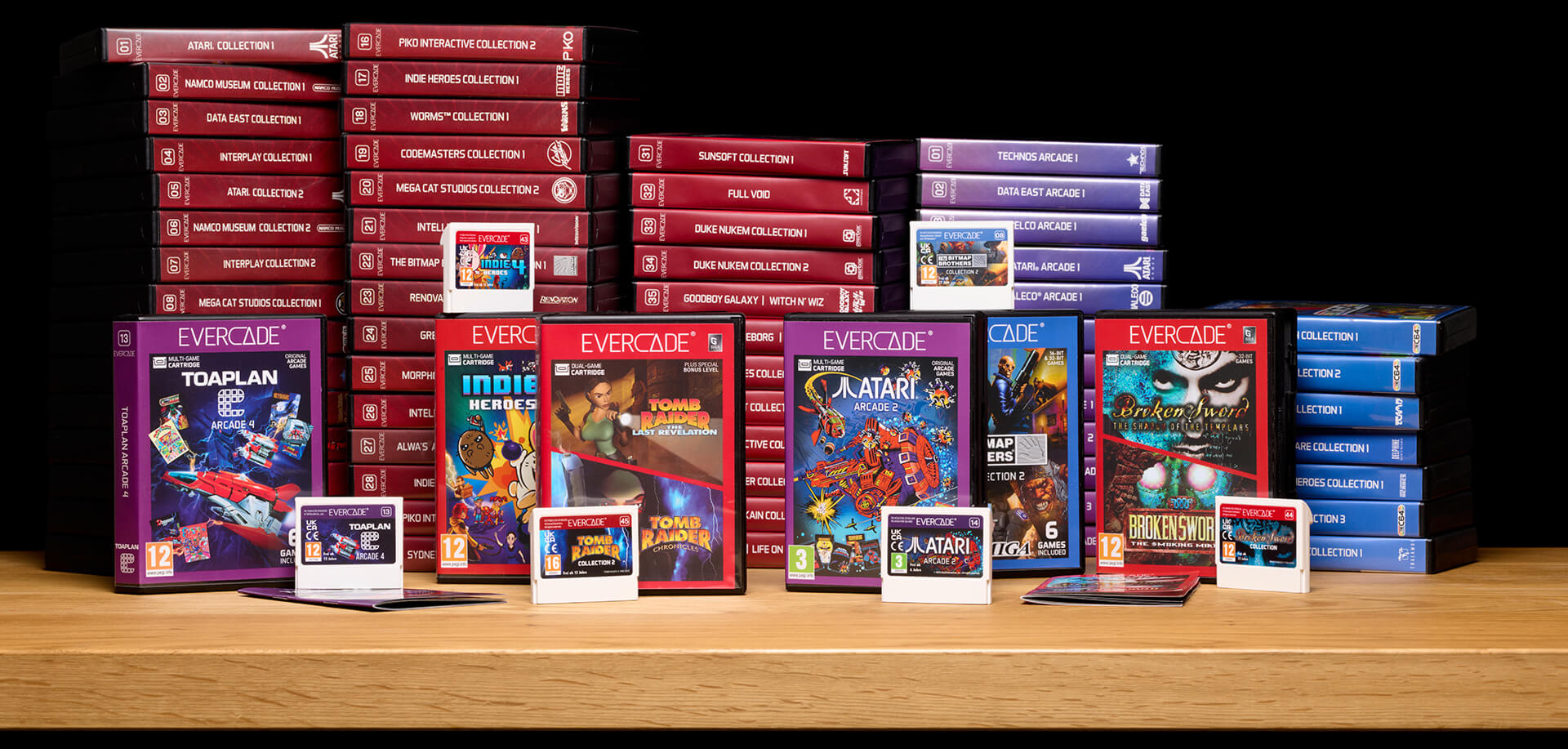
Six years later, I’m happy to admit I was wrong, and that the opposite has happened. By the end of the year there will be 90 Evercade cartridges, offering a total of more than 750 games to play. Just last week it was announced that System 3’s James Pond and The Last Ninja series will be coming to the device, two series that I personally loved back in the day.
What’s more, Blaze has improved its hardware since that original Evercade handheld too. It’s since been replaced by the Evercade EXP (and then the redesigned EXP-R), which feels more solid and can also be turned vertically to play some arcade games in TATE mode.
The Evercade ecosystem has also expanded to include a home console, the Evercade VS (and the cheaper redesign, the VS-R). There’s a series of bartop arcades called Evercade Alpha, and a bunch of standalone Game Boy-shaped handhelds called the Super Pocket series, each with their own selections of built-in games.
The important thing here is that no matter which form factor you go for – wide handheld, Game Boy-style handheld, home console or mini arcade – every single Evercade device has at least one cartridge slot (sometimes two) so they can play the continually growing library of Evercade games.
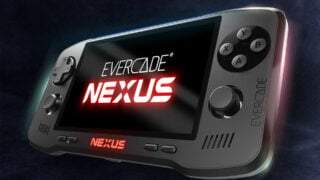
Later this year, Blaze returns to that original handheld form factor it started with for the next generation of Evercade devices, the Evercade Nexus. Due at the end of October, the Nexus promises to build on everything that Blaze has learnt so far to provide its best handheld device yet.
After going hands-on early with the Nexus at Gamescom, it certainly feels to me like a sizable step forward for Blaze and the Evercade brand, delivering everything the previous handheld did but offering more on top.
The Nexus is Evercade’s largest handheld, with a 5.89” IPS screen (somewhere in between a Switch and Switch Lite). It also adds twin sticks, something Evercade is only just starting to introduce. Every Evercade device has only featured a D-Pad up to this point, and Blaze just recently released a wireless controller – mainly for the VS-R console, but compatible with other devices – which also features twin sticks.
While this isn’t important for the vast majority of Evercade games which are already out – given that we’re mainly talking 8-bit and 16-bit titles, analogue sticks have never really come into the equation – in recent years PlayStation games have started appearing more frequently on Evercade carts, and the Nexus will be launching with a cartridge featuring two N64 games, Banjo-Kazooie and Banjo-Tooie.
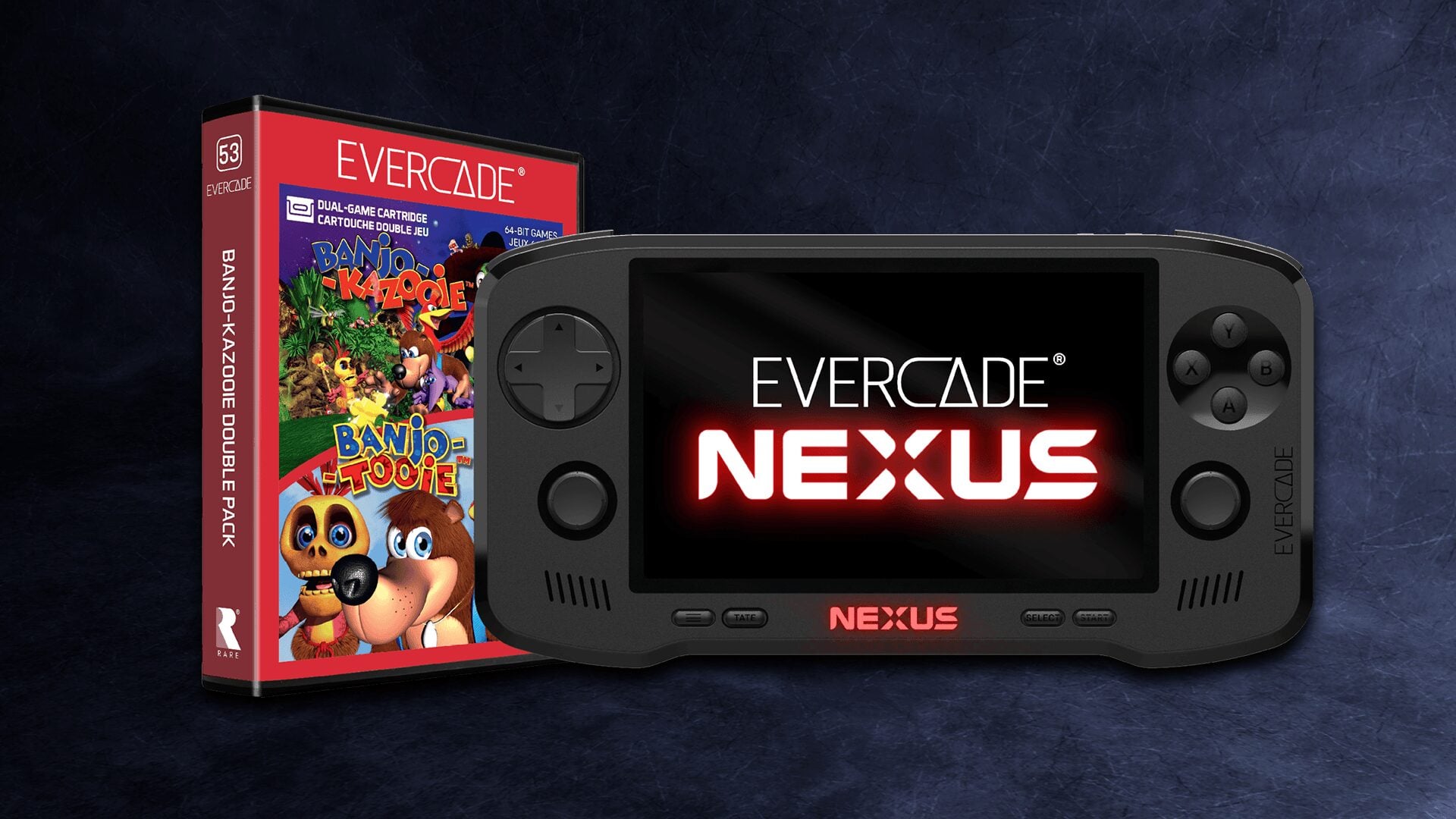
I tried out Banjo-Kazooie running on the Nexus and, as previously reported, it’s not just the existing ROM running on a Nintendo 64 emulator, but an entirely new port of the game created natively for the Evercade hardware.
This means the game not only runs at a sharper resolution, but also now supports a native widescreen display and runs at 60 frames per second. You can now also rotate the camera with the right stick (something the N64 original, with its single stick, couldn’t do).
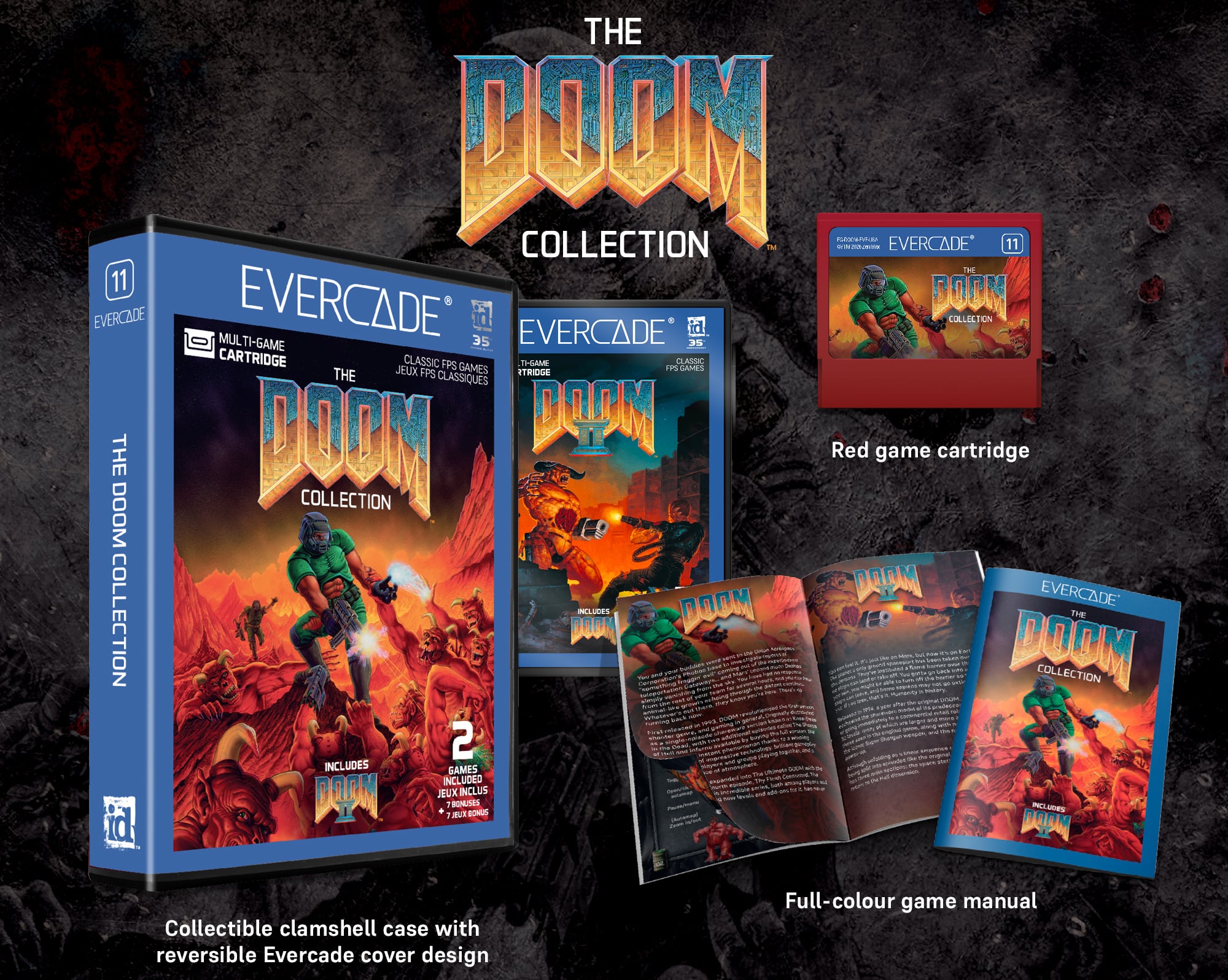
I also briefly went hands-on with the upcoming Doom Collection cartridge, set to release on the same day. This contains Doom, Doom 2 and six official mission packs and is once again a native port, meaning smooth twin-stick controls and a bunch of new modifiers exclusive to the Evercade version.
As well as the introduction of twin sticks, the Nexus also improves connectivity, adding WiFi 6 support as well as a new streaming feature called EverSync. If you and a friend both have a Nexus, you can stream your game to them and you can both play against each other using a single cartridge, similar to Switch 2’s GameShare feature. And yes, TATE mode is back, and available at the press of a button.
While my time with the Nexus was all too brief, I’m already confident that it’s shaping up to be the best Evercade handheld to date. So far so good, then, but the full verdict will come after I get to properly put the Nexus through its paces before launch, and deliver our full review nearer to October 30.